Grants to Community Partners
The City will competitively award sub-grants to local nonprofits, faith-based organizations, treatment providers, and community coalitions to deliver services aligned with the objectives above. Applicants will be asked to demonstrate evidence of need, alignment with best practices, measurable outcomes, and sustainability plans.
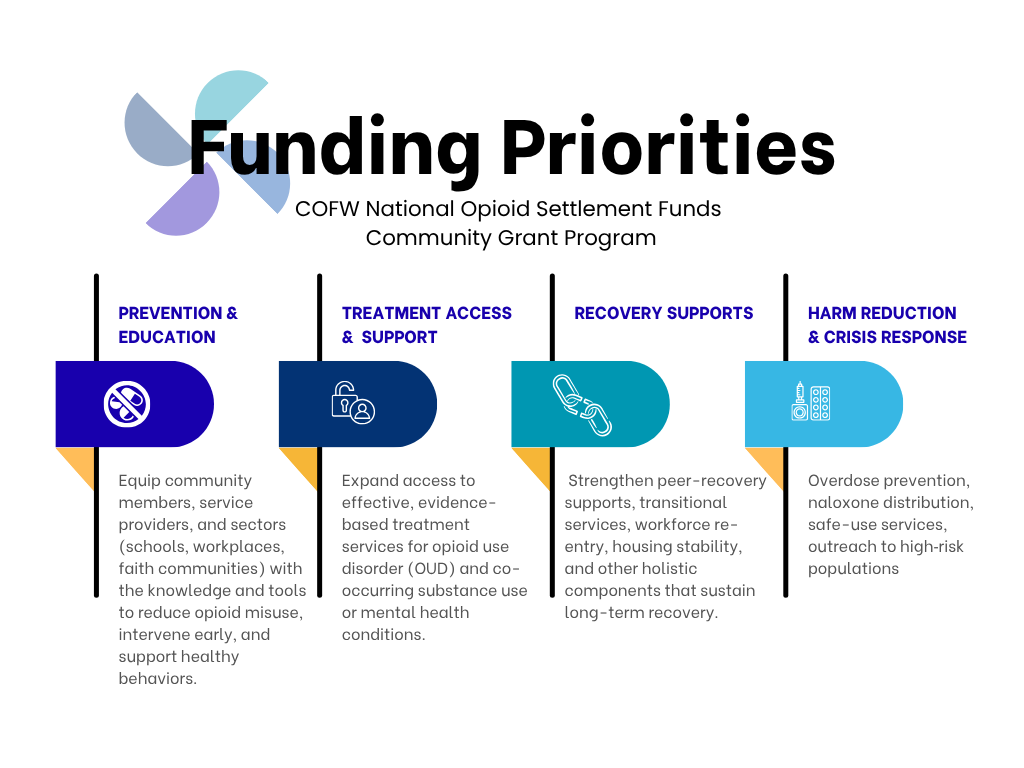
- Prevention & Education – Equip community members, service providers, and sectors (schools, workplaces, faith communities) with the knowledge and tools to reduce opioid misuse, intervene early, and support healthy behaviors.
- Treatment Access & Support – Expand access to effective, evidence-based treatment services for opioid use disorder (OUD) and co-occurring substance use or mental health conditions.
- Recovery & Aftercare – Strengthen peer-recovery supports, transitional services, workforce re-entry, housing stability, and other holistic components that sustain long-term recovery.
- Harm Reduction & Crisis Response - Overdose prevention, naloxone distribution, safe-use services, outreach to high‐risk populations
- Community Data & Innovation – Use local data and best practice models to identify hotspots, emerging trends, and priority populations; encourage innovative pilot programs and cross-sector partnerships.
- Governance & Accountability – Ensure funds are used ethically, effectively, and with accountability through oversight mechanisms, community engagement, and regular reporting.
While open to a broad range of community-based organizations and service providers, the City will give priority to proposals that:
- Serve populations with high unmet need (e.g., individuals with OUD, co-occurring disorders, justice-involved populations, rural/metro fringe).
- Demonstrate partnerships across systems (behavioral health, public safety, housing, workforce).
- Use evidence-based or promising practices grounded in local data.
- Include sustainability plans beyond the initial funding period.
- Provide mechanisms for peer voice or lived experience integration.
A dedicated oversight committee—the COFW National Opioid Settlement Committee—has been established by ordinance to guide the allocation and community engagement process. The COFW National Opioid Settlement is comprised of community stakeholders, subject matter expects and people with lived experience who have been appointed by the Mayor and the City Council.
- The COFW National Opioid Settlement Committee will meet monthly to review funding strategies, approve funding recommendations, monitor progress, and facilitate community input.
- A public-facing report will be made available annually to document fund allocations, service outcomes, and budget performance.
Over the coming years, the City anticipates that this program will:
- Increase the number of residents accessing evidence-based OUD treatment and peer-led recovery support.
- Reduce opioid-related overdose deaths and emergent harms (such as fentanyl exposure).
- Strengthen community capacity to respond to substance use and related mental health challenges.
- Foster sustainable partnerships across healthcare, justice, housing, workforce, and faith sectors.
- Improve the quality of life and social-economic outcomes for individuals, families, and neighborhoods affected by the opioid crisis.
ALL APPLICATIONS ARE CURRENTLY CLOSED
Request for Applications
Introduction
The City of Fort Wayne is soliciting applications from qualified nonprofit organizations and community-based entities to deliver programs that prevent, treat, and mitigate the effects of opioid use disorder (OUD) and substance use disorder (SUD).
This funding opportunity is made possible through Indiana’s opioid settlement fund and must align with Exhibit E: Strategies for Effectively Allocating Opioid Settlement Funds.
The City’s goal is to support evidence-based, community-centered programs that improve health outcomes and expand access to treatment, prevention, harm reduction, recovery supports, and public education across Fort Wayne.
Eligible applicants
Eligible applicants include:
- 501(c)(3) nonprofit organizations, faith-based organizations providing community services, entities registered with the Indiana Secretary of State and located in or serving Fort Wayne, Indiana.
- Applicants must demonstrate experience addressing substance use (OUD or SUD), and co-occurring conditions, or community-based prevention.
- Applicants must be in good standing with the Indiana Secretary of State or similar.
- Applicants must serve Fort Wayne residents.
- Applicants must be able to provide at least one year of financial statements and tax returns.
- Collaborative proposals with multiple partners are encouraged.
Funding priorities
In alignment with Exhibit E, the City will prioritize proposals that:
- Address treatment, prevention, and harm reduction for individuals with or at risk of OUD/SUD.
- Provide services to populations disproportionately affected (e.g., youth, justice-involved individuals, unhoused residents, veterans, and people with co-occurring mental health disorders).
- Expand access to Medication-Assisted Treatment (MAT), naloxone distribution, and trauma-informed care.
- Strengthen data-driven evaluation, evidence-based practices, and measurable outcomes.
Application submission requirements
Applications must include the following components:
- 4.1 Contact Sheet
- Organization name, address, EIN, contact information, requested amount, and total program budget.
- 4.2 Organization Profile
- Mission, history, years of operation, and service area.
- 4.3 Program Narrative (Character limits apply; see online application)
- Purpose & need addressed.
- Target population and geography served.
- Description of program activities and Exhibit E alignment.
- Expected activities, outputs (e.g., clients served) and outcomes (e.g., reduced overdose events).
- Implementation timeline.
- 4.4 Evidence Base & Evaluation
- Evidence-based models used, research citations, data collection and reporting plan, outcome indicators and measurement methods
- 4.5 Budget & Budget Narrative
- Budget & Budget Narrative: clearly itemize costs and justify how funds will be used
- 4.6 Partnership Summary: list key collaborators and their roles (with MOUs or Letters of Support if available).
- 4.7 Required Attachments
- Required for all applicants:
- IRS 501(c)(3) determination letter
- Board of Directors list if applicable
- Form 990 or independent audit or similar annual tax filing.
- Current-year financial statements
- Proof of general liability and workers’ compensation insurance
- Project/ Program Budget
- Organizational Budget
Applications missing required attachments will not be reviewed.
Application format and delivery
Applications must be submitted online through the City’s grants portal.
Late or incomplete submissions will not be accepted.
Review criteria
Applications are scored using a standardized rubric:
| Category | Weight |
| Missional Alignment | 20% |
| Organizational Capacity & Readiness | 30% |
| Evidence-Based Model & Program Design | 30% |
| Measurable Success (Outputs & Outcomes) | 30% |
| Partnerships & Collaboration | 20% |
| Financial Feasibility & Budget Alignment | 10% |
| Community Impact (underserved populations) | Additional Consideration |
| New or Existing Activity | Additional Consideration |
Grants are reviewed by the Opioid Settlement Fund Review Committee, appointed by the City Council and the Mayor. The OSF Review Committee makes recommendations to the Mayor for approval.
Funding terms & conditions (Updated for 2026)
- 7.1 Grant Period
- April 1, 2026 – March 31, 2027 for applications due January 30, 2026
- Oct 1, 2026 – September 30, 2027 for applications due July 30, 2026
- (Grant periods may vary within this range ie. 6 or 12 months)
- 7.2 Updated Funding Caps
- The Committee recommended the following limits beginning in 2026:
- Up to $50,000 per application per cycle; Maximum $100,000 per organization per year
- Exceptions may be granted only in rare cases for transformational projects
- Singular expenses over $10,000 will require 3 bids (if approved – not required for application).
- 7.3 Application Limit
- One application per organization per cycle
- Large institutions must prioritize internally
- Organizations may apply in future cycles as long as they do not have an active award, or their current award will end before the new award period begins.
- 7.4 Reporting Requirements
- Quarterly program reports and Monthly financial reports
- 7.5 Audit & Monitoring: City reserves the right to review all program and financial records.
- 7.6 Insurance Requirements
- General liability coverage: minimum $1,000,000 and Workers’ compensation for staff providing services
- 7.7 Conflict of Interest
- Applicants must disclose any potential conflicts of interest
Key dates
|
Event |
Date |
|
RFA Issued |
December 5, 2025 |
|
Technical Assistance |
December 18, 2025 – 10:00 AM |
|
Application Window Opens |
January 2, 2026 |
|
Technical Assistance |
January 7, 2026 – 3:00 PM |
|
Weekly Office Hours |
Tues/Thurs, 1–4 PM |
|
Questions Due |
January 10, 2026 at 5 PM |
|
Answers Posted |
January 15, 2026 |
|
Applications Due |
January 30, 2026 at 11:59 PM |
|
Award Announcement |
February 28, 2026 |
Additional information
The City reserves the right to:
- Reject any or all applications
- Adjust awarded amounts based on funding availability
- Request clarification or additional documentation
- Conduct site visits pre- or post-award
- Applications become public record under Indiana’s Access to Public Records Act.
Mini Grant RFA
Introduction
For Small/Emerging Organizations & Pilot Projects
The City of Fort Wayne invites applications for OSF Mini Grants to support small or emerging organizations, new or early-stage entities, and pilot projects that advance opioid prevention, harm reduction, treatment access, recovery support, or system-improving activities aligned with Exhibit E of the National Opioid Settlement.
Mini Grants are designed to lower barriers for new and growing organizations by offering a short, simple application process and a project period of 3–6 months.
Mandatory pre-application requirement
All applicants must meet with the Opioid Settlement Manager prior to submitting an application.
This conversation ensures project alignment with Exhibit E, confirms eligibility, and provides technical assistance for developing a strong proposal.
Appointments may be scheduled via email.
Contact: Sarah Lance | [email protected]
Who should apply
Mini Grants are intended for:
- Organizations with limited or no financial history
- Community groups, grassroots organizations, and early-stage nonprofits
- New ideas or pilot projects testing fresh approaches
- Projects that address needs related to opioid use disorder (OUD/SUD) within Fort Wayne
Applicants must operate within the City of Fort Wayne and propose activities clearly linked to Exhibit E categories.
Funding amount & timeline
- Maximum Request: up to $10,000
- Project Period: 3–6 months
- Application period: March 1, 2026, to March 16, 2026
- Start Date: May 1, 2026 (recommended)
- For this project, we will provide 50% of the funds upfront and the remaining 50% upon project completion; documentation is required (receipts, payroll journals, invoices, etc.)
Application components
Applicants must complete the Mini Grant Application and provide:
- Organization Information
- Big Idea & Project Definition
- Project Timeline & Milestones
- Success Measures (outputs/outcomes)
- Community Support & Differentiation
- Budget & Ability to Track Expenses
- Required Attachments
- W-9
- Certificate of Insurance naming the City as Additional Insured
- Fiscal sponsorship documents (if applicable)
Review criteria
Applications will be reviewed based on:
- Alignment with Exhibit E and OSF priorities
- Clarity, feasibility, and innovation of the project
- Potential community impact
- Ability to track expenses and document activities
- Demonstrated support, partnerships, or community readiness
Emerging organizations and pilot ideas are encouraged; lack of financial history will not disqualify applicants.
Submission deadline
Applications must be submitted via eCivis by:
Monday, March 16, 2026, at 11:59 PM EST.