Crime in the Packard Area
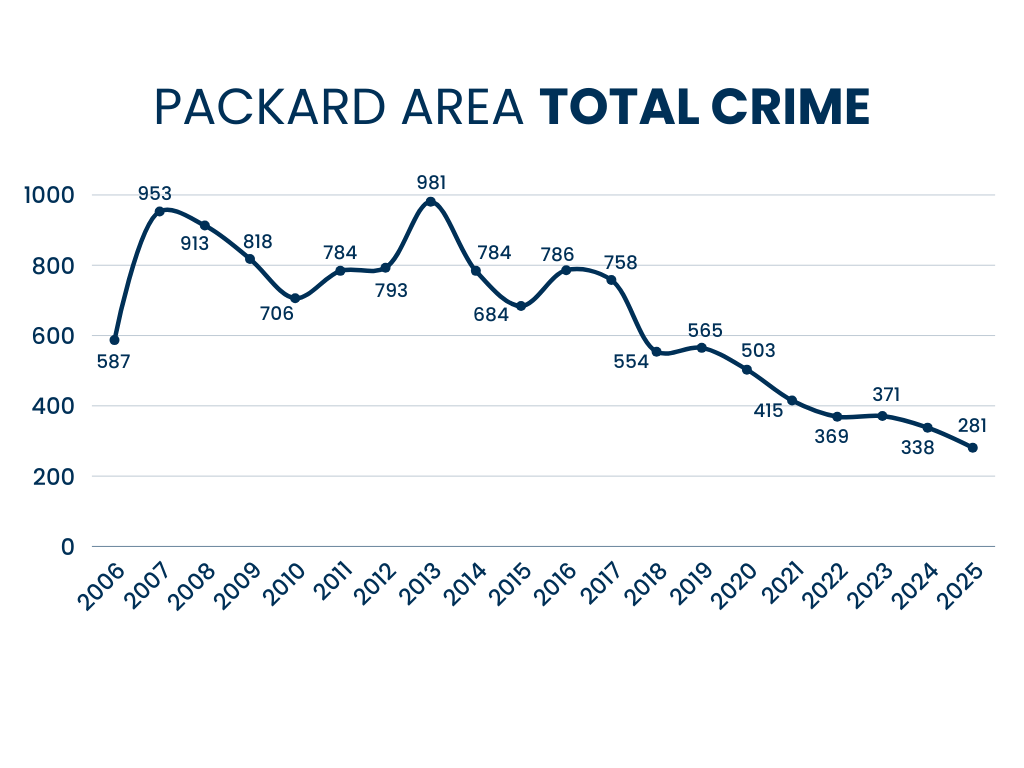
The Packard Area, encompassing 18 neighborhoods in south central Fort Wayne, has experienced substantial long-term crime reductions in overall crime, particularly in nonviolent and property-related offenses. While residents have consistently expressed concern about neighborhood safety, especially related to burglary and visible disorder, long-term police data tells an ultimately encouraging story about safety in the neighborhoods.
Across nearly two decades of data, total crime has declined by more than half, falling from a peak of nearly 1,000 reported incidents in 2007 and 2013 to approximately 280 incidents today. This downward trend is driven primarily by a sharp decline in nonviolent and property crime in the neighborhoods.
*Importantly, this data is not meant to invalidate residents' lived experience or perceptions of safety, but is provided as a foundation for targeted, neighborhood-level strategies that help strengthen safety and improve the quality of life.
Nonviolent Crime
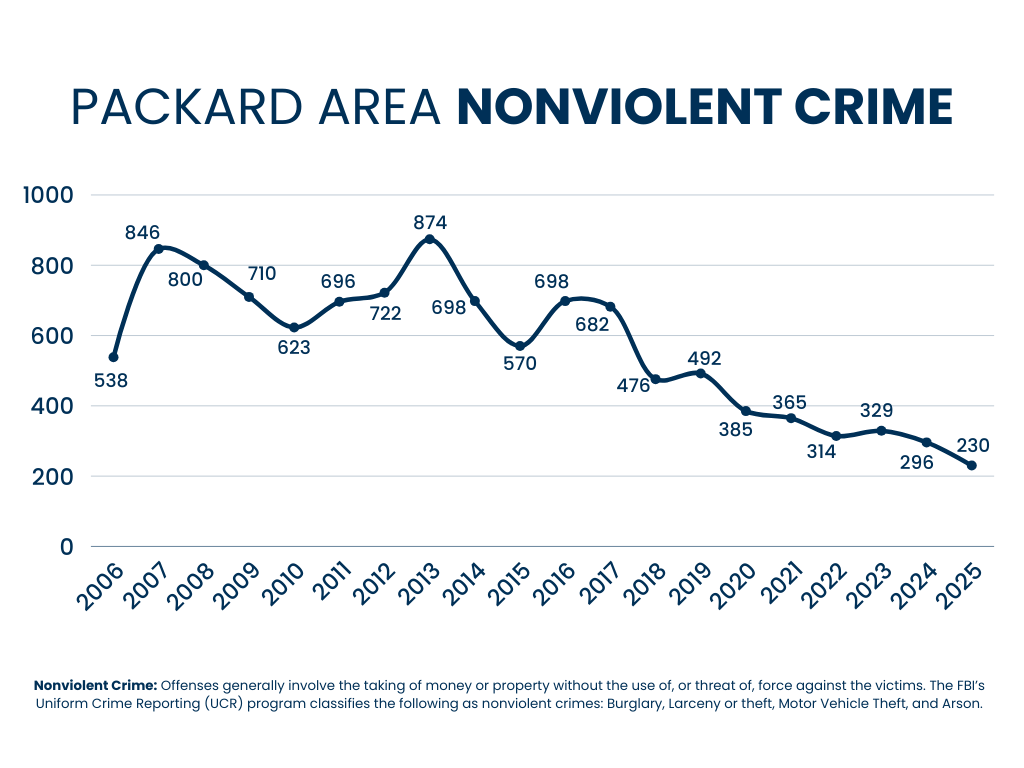
Nonviolent crime, which, according to the FBI Uniform Crime Rates, includes burglary, larceny, motor vehicle theft, and arson, has seen the largest reduction in crime across the Packard Area.
- Nonviolent crime peaked around 2013 with 874 total incidents, and has steadily declined since.
- By 2025, nonviolent crime had dropped to approximately 230 total incidents, representing a reduction of more than 70% from its peak in 2013.
This sustained decline suggests that long-term investments in the Packard Area, including housing stability, neighborhood organization, code enforcement, and recent lighting, sidewalk, and alley investments, have made a measurable difference. These improvements align closely with Crime Prevention Through Environmental Design (CPTED), which emphasizes the importance of visibility, maintenance, and community members' collective responsibility.
Violent Crime
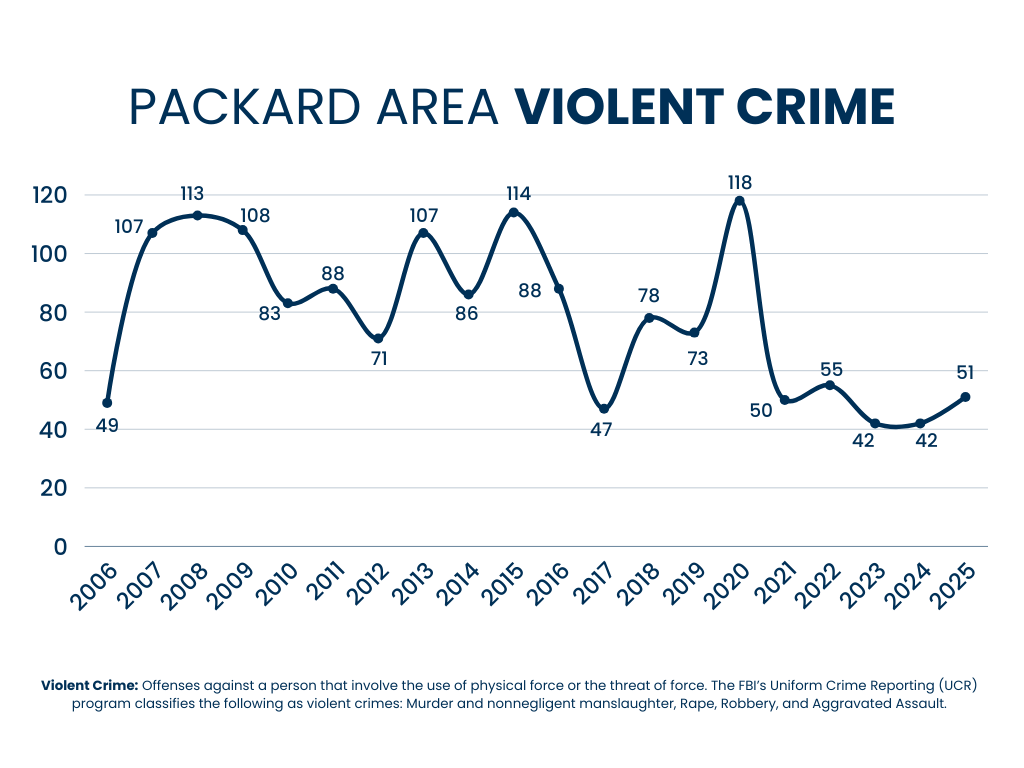
Violent Crime, which includes aggravated assault, robbery, and homicide, has had a steady and significant decline overall in the Packard Area.
- Violent Crime had multiple peaks between 2007 and 2015, along with a notable spike in 2020 due to increased cases of aggravated assault.
- Since 2020, violent crime has dropped sharply and has now stabilized, reaching approximately 51 total incidents in 2025, or 18.1% of total crimes committed in the Packard Area.
Overall, violent crime in the Packard Area has decreased, largely because robberies are far less common today and serious assaults have remained mostly stable over time. Robbery, which strongly affects how safe people feel in their neighborhoods, has declined since the late 2000s and is now rare compared with earlier years. Aggravated assault has seen ups and downs, including a noticeable increase in 2020, but those levels did not continue and have since returned closer to what the neighborhood experienced before the pandemic. These trends show that while serious incidents still happen and deserve attention, violent crime is not rising overall in the Packard Area. Continued investment in lighting, neighborhood connections, and support services helps create safer streets and stronger communities for everyone.
Burglary
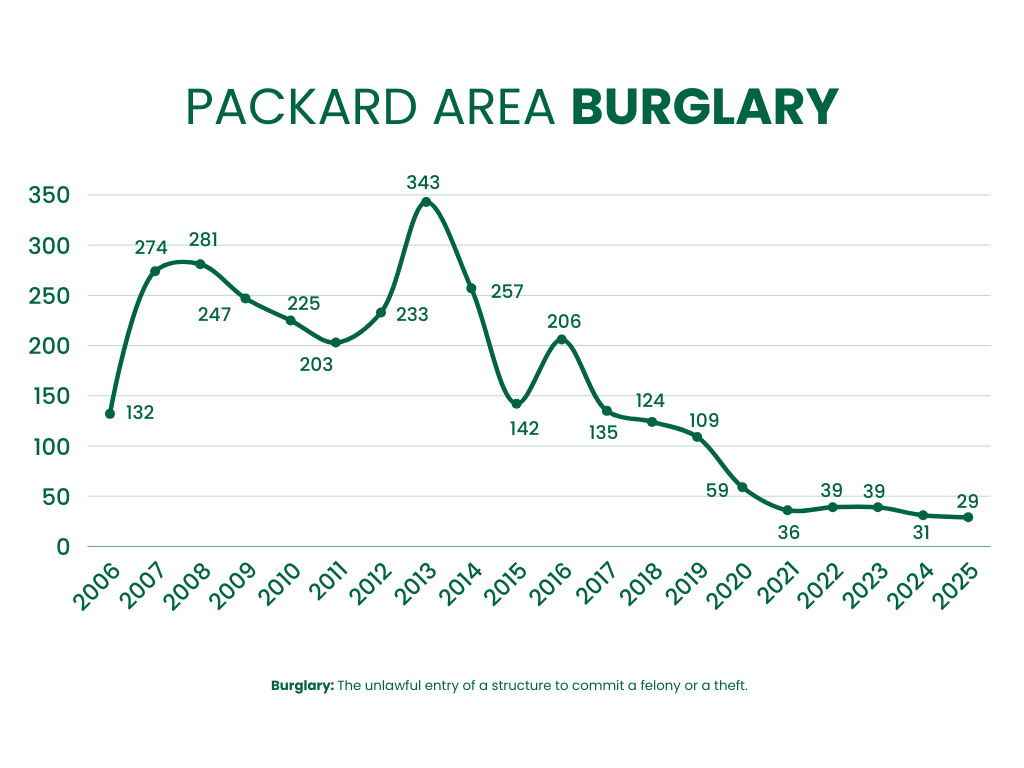
Burglary, which is defined as the unlawful entry of a structure to commit a felony or a theft, has historically been one of the most frequently cited resident concerns in the Packard Area. This often is one of the most common crimes that are associated with poor perceptions of personal and property safety. However, in Packard, burglary has also seen one of the most dramatic declines over time.
- In 2013, burglary peaked at 343 incidents total.
- By 2025, burglaries fell to just 29 incidents total, which is a reported decline of more than 90% from the peak.
This trend reflects the effectiveness of two important strategies which have been supported through the adoption of Packard 2030. The first is called target-hardening, which involves adding street lighting and access controls. The other is the role of social capital and social infrastructure, which is healthy neighborhood associations, community events, improved community gathering spaces and residents looking out for one another. These are both informal systems of neighborhood accountability and should be used in tandem with enforcement.
Larceny
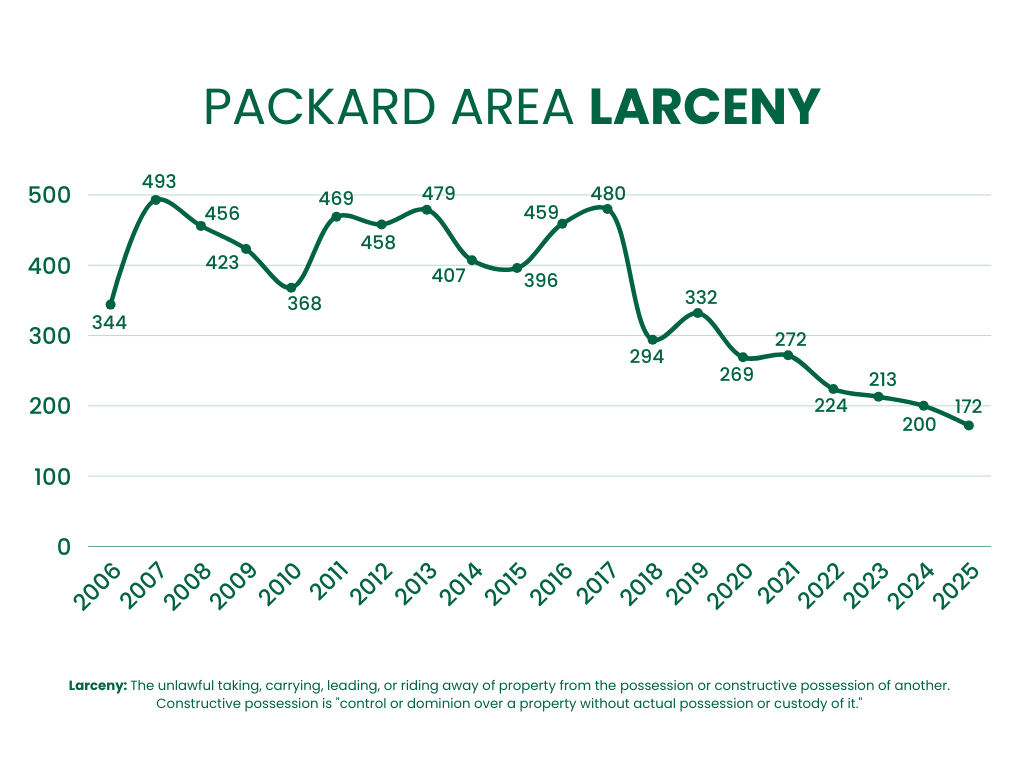
Larceny, which is defined as the unlawful taking, carrying, leading, or riding away of property from the possession or constructive possession of another, is synonymous with theft (which is also included in this category). As you can see by the chart below, Larceny remains one of the more common crime types in the Packard Area, although long-term trends show a clearly positive trajectory.
- Larceny peaked from 2006 to the early 2010s, with several years exceeding 450 incidents per year.
- By 2025, Larceny declined to approximately 170 incidents, continuing a steady downward trajectory.
While larceny is still present, the decline suggests improvements in the neighborhood, including the use of Crime Prevention Through Environmental Design strategies, along with property awareness, investment in commercial corridors and economic stabilization have all played an important role in this reduction. Additionally, efforts should be made to improve neighborhood lighting, encourage homeowners to secure storage, and residents have a shared pride and responsibility in public space are all important to the success of the Packard area.
Robbery
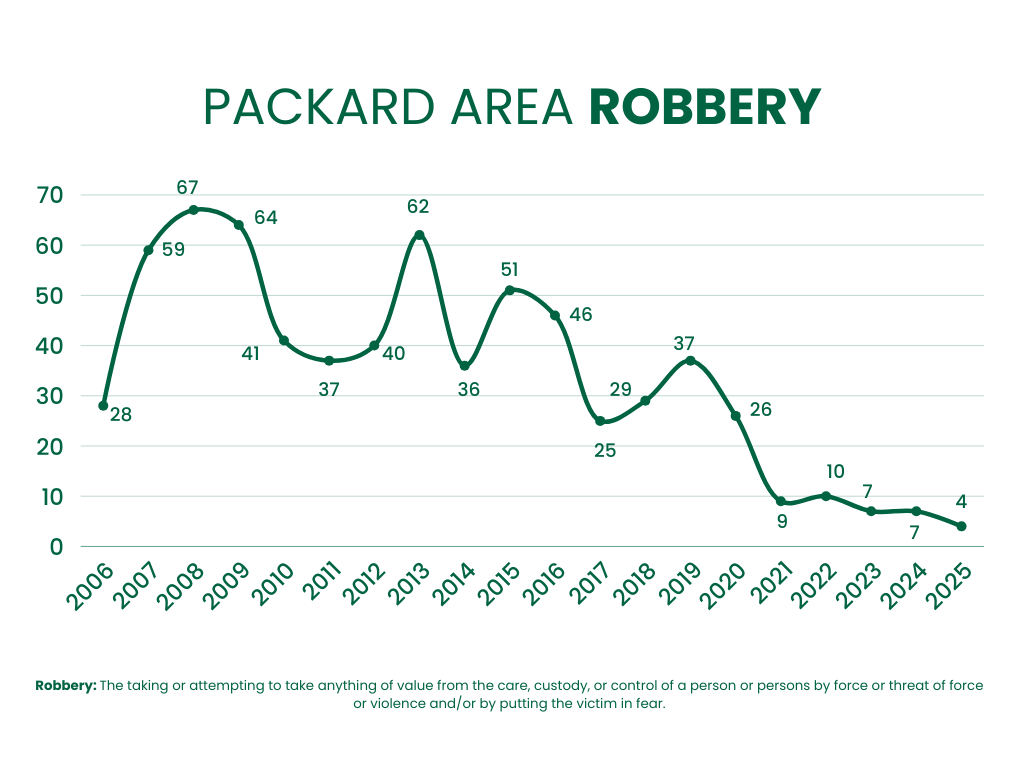
Robbery, which is defined as the taking or attempting to take anything of value from the care, custody, or control of a person or persons by force or threat of force or violence and/or by putting the victim in fear, has experienced one of the most substantial long-term declines of any crime category in the Packard Area.
- In the late 2000s, robbery was a frequent concern, peaking at 67 incidents in 2008.
- By 2021, incidents of robbery fell into the single digits, with just 4 total robberies in 2025.
The Packard Area has seen a significant reduction in robberies, almost a 90% drop from its peak. This downward trend is particularly significant given that robbery is one of the most visible and personal crimes, which can strongly influence perceptions of neighborhood safety. While there are likely numerous factors that have led to the overall decline in robberies, meaningful improvements in lighting and pedestrian activity, core principles of Crime Prevention Through Environmental Design (CPTED), have likely assisted with this drop. Increased neighborhood presence and stronger social connectivity between neighbors have also likely reduced opportunities for robbery by increasing visibility. This data shows that sustained, neighborhood-scale interventions in the Packard Area have helped reduce violent crimes over time.
Aggravated Assault
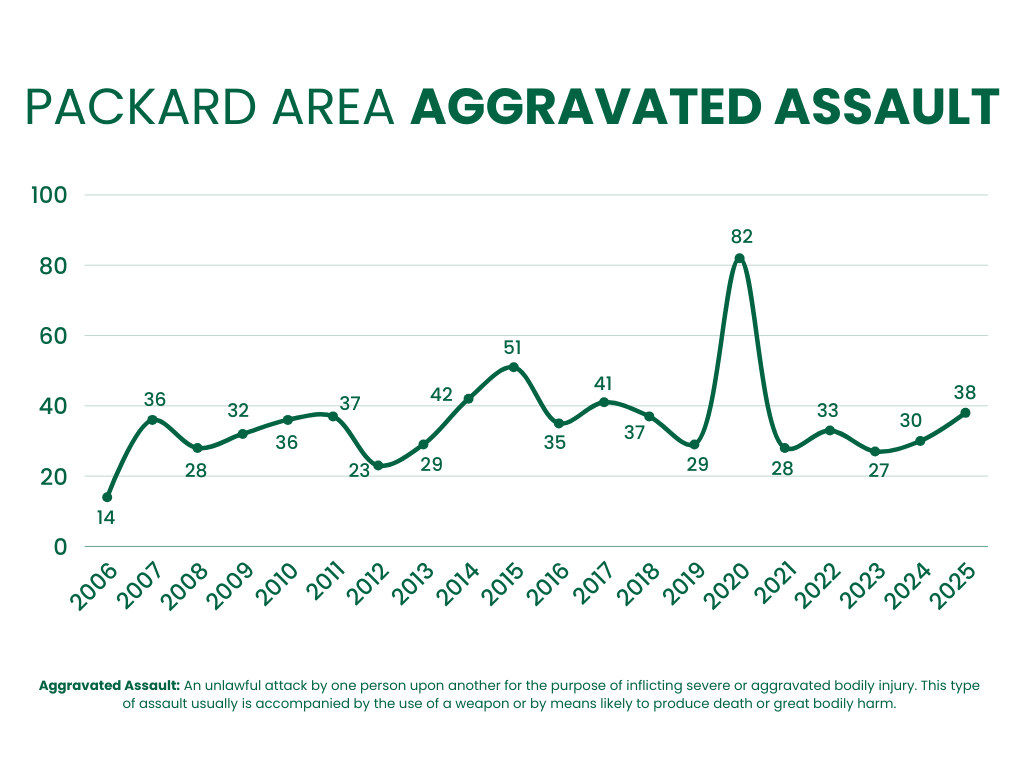
Aggravated Assault is considered an unlawful attack by one person upon another, which is intended to cause serious bodily injury or harm. From 2006 to 2019, aggravated assaults fluctuated between 25 and 50 incidents per year, reflecting a relatively stable pattern when compared to other violent crimes. However, Packard Area, along with many other communities, saw a pronounced spike in 2020, when incidents rose sharply to 82 cases, the highest level observed in the past two decades. This spike aligns with broader national trends observed during the COVID-19 pandemic when increased social stress, economic disruption, isolation, and reduced access to services likely contributed to elevated levels of serious interpersonal violence.
- After the peak in 2020, Aggravated Assault dropped to 28 incidents in 2021.
- While rising modestly to 38 incidents in 2025, Aggravated Assault remains well below the 2020 peak.
While these post-pandemic trends suggest that aggravated assault remains an important area of concern, it is closely tied to factors beyond the neighborhood's built environment alone. These include mental health, substance abuse, domestic conflict, and economic stress, all of which are interpersonal. Reducing aggravated assault requires not only safer spaces for residents but stronger social connections that help prevent crises before they escalate.